AI video20 min read
AI Video Ads for Skincare Brands: Formats, Claims Rules and a Testing Plan (2026)
AI video ads for skincare brands work best when AI shows the product and real people show the results. Use AI for texture macros, ingredient stories, routine demos and fast hook variants. Never use it to invent glowing skin, fake a before/after or put words in a "doctor's" mouth that nobody qualified signed off.
That one rule sorts out most of the risk. The rest is craft: picking formats that match the funnel, adapting them for heat, humidity and bilingual audiences in the GCC, and testing enough variants to find a winner before the audience gets bored.
This guide is for DTC and retail skincare teams in Dubai, the wider Gulf and global markets. You'll get the formats that perform, a claims checklist, a GCC playbook, a production workflow, a testing and refresh plan, and an honest list of jobs AI should not do.
Why Skincare Is a Special Case for AI Video Ads
Skincare sells a promise you can't see in a photo: how a serum feels, how fast a moisturizer sinks in, whether sunscreen leaves a cast. Video closes that gap better than any static ad. That's why short-form video sits at the center of almost every skincare media plan on Meta, TikTok and YouTube Shorts.
AI changes the economics of making that video. Instead of one shoot that produces six usable cuts, you can produce dozens of concepts and variants from your packshots, brand assets and a handful of real clips. But skincare is also one of the most heavily policed ad categories, because the product touches the body and buyers are making decisions about their skin.
What AI does well for skincare
AI is strong at anything that is about the product itself:
- Texture and motion: a cream swirl, a gel splitting, a serum drop landing on glass, a sunscreen spreading thin.
- Environments: a bathroom shelf at golden hour, a beach bag in Jumeirah, a cool marble counter, without booking a location.
- Ingredient visuals: a stylized niacinamide molecule, a hyaluronic acid "water web," botanicals floating in clear gel.
- Variants at volume: the same concept in 9:16, 4:5 and 1:1, with five different hooks and two languages.
- Speed: a new concept in days rather than the weeks a full shoot takes to plan, cast and edit.
Where AI creates risk
AI is weak, or dangerous, anywhere the ad implies proof:
- Skin itself. Generated skin tends to drift toward poreless, filtered perfection. On a skincare ad, that reads as a result claim even if you never meant it as one.
- Transformation. Any AI-made "after" frame is a fabricated outcome.
- Authority. A synthetic person in a white coat implies medical endorsement.
- Labels and packaging. Models still warp small text, ingredient lists and logos, which can turn a compliant pack into a misleading one.
So the job is not "AI or no AI." It's deciding, shot by shot, which parts of the ad are product storytelling (AI is fine) and which parts are evidence (real footage, real people, real data only).
The Hard Rule: Never Fake Skin Results
We hold one non-negotiable rule on every skincare project: AI never creates or alters what happens to skin. No generated before/after, no AI morph from "dull" to "glowing," no smoothing a real customer's face, no synthetic testimonial claiming "my acne cleared in two weeks."
The same principle holds in every category we produce for. In our guide to AI video for real estate marketing, the equivalent rule is that an AI render can never pass for the actual apartment a buyer will walk into. In skincare, the "apartment" is your customer's face.
What counts as a result claim
A result claim is anything that tells the viewer what the product will do to their skin. That includes:
- Explicit words: "reduces dark spots," "clears breakouts," "visibly firmer in 14 days."
- Visual proof: before/after splits, zoom-ins on "improved" skin, timelapses of a blemish fading.
- Implied authority: lab coats, clinic settings, "dermatologist approved" badges, "clinically proven" supers.
- Numbers: "93% saw brighter skin," "2x hydration."
Every one of these needs real substantiation: a study, a consumer-perception trial with a stated sample, or genuine footage of real people with their consent. If you can't back it, cut it. If you can back it, show the real evidence, not an AI interpretation of it.
What platforms and regulators expect
The ad platforms are explicit about this. TikTok's ad policy on misleading and false content rejects exaggerated or unrealistic claims about what a product does, and before/after imagery for cosmetic results is a common reason skincare ads get rejected. Google's misrepresentation policy covers ads that mislead users about a product's effects. Meta's Advertising Standards add rules on personal health, body image and implied knowledge of a viewer's condition, so a hook like "Struggling with your acne?" can get flagged before anyone judges the visuals.
Regulators look at the same thing from the consumer side. In the UAE, cosmetics are registered before sale and advertising content standards set by the UAE Media Council apply to brands and to the creators they pay. In the US, UK and EU, consumer protection rules require that claims are truthful and substantiated, and AI-generated people presented as real customers can be treated as deception. If you sell across markets, write to the strictest rule you'll face and adapt from there.
AI adds one more layer: disclosure. Meta, TikTok and YouTube all have labeling expectations for realistic AI-generated or altered content, and the rules keep evolving. Our working rule is simple. If a viewer could reasonably believe an AI person is a real customer, either label it clearly or don't run it.
A simple claims checklist for every AI ad
Before any skincare ad leaves our studio, it passes these checks:
- Every claim in voiceover, supers and captions maps to a source in the brand's claims file.
- No AI-generated or AI-altered skin shown as a result.
- Any before/after uses real, unretouched footage of a real person, with consent and matching light.
- No synthetic "doctor," lab coat or clinic setting unless a named, qualified professional reviewed and approved the script.
- The product label, ingredient names and SPF figure on screen match the real pack exactly.
- AI disclosure is applied where the platform requires it or a viewer could be misled.
- Hooks don't assume the viewer has a condition ("your acne") and instead speak to the situation ("if breakouts show up after the gym").
7 AI Video Ad Formats That Work for Skincare
These are the formats we see carry skincare budgets most often, ranked by how much of the work AI can safely do.
1. Texture macros
The classic. A slow-motion swirl of cream, a gel sheet cracking, a drop of serum sliding down a dropper. Texture macros make the viewer imagine the product on their skin, which is the whole job of a cold-audience opener.
AI is excellent here because the subject is the product, not a person. Start from a high-resolution packshot and a real reference clip of the actual texture, so the generated version matches viscosity and color. A thick balm that looks watery in the ad will produce returns. The sensory, slow-reveal approach overlaps with fragrance, and we cover more of that craft in our guide to AI video production for perfume brands.
2. Ingredient stories
A 10 to 20 second explainer: what the hero ingredient is, why it's in the formula, and how it fits the routine. Think "niacinamide for oil control in humid weather" or "ceramides for skin that's been in air conditioning all day."
AI handles the visual metaphors well: molecules, botanicals, a cutaway of the skin barrier shown as an illustration rather than real skin. Keep the language to what the ingredient is known to do, and avoid turning an ingredient fact into a product result. "Niacinamide is widely used to help balance the look of oily skin" is a different claim from "this serum stops oil."
3. Routine demos
Morning or evening routine, step by step: cleanse, treat, moisturize, SPF. Routine demos answer the question shoppers actually have ("where does this go in my routine?") and they work at every funnel stage.
This is a hybrid format. Hands applying product, bottles on a shelf and the sequence on screen can be AI-assisted. Real application on real skin is better shot on camera, even on a phone, because viewers check how the product spreads and finishes. A good pattern is a real-hands opener, AI-built product transitions, and on-screen step numbers.
4. AI UGC
Creator-style videos with an AI presenter talking to camera, unboxing, or reacting to the product. Done well, AI UGC lets you test 10 hooks and five personas in the time it takes to brief one creator. If you're new to the format, our explainer on what AI UGC is and where it fails covers how it's built.
For skincare, keep AI UGC to experience and routine statements ("I keep this in my gym bag," "this is the step I never skip before the school run"), never results ("my pigmentation is gone"). We've seen this work in practice. On a premium UAE skincare launch, an AI-generated UGC video became the winning ad of the brand's first Meta campaign, delivering 77 purchases on its own, out of more than 80 creatives we produced. You can read the skincare launch case study for the full story.
5. Dermatologist-style explainers (and their limits)
Expert-led education converts in skincare because shoppers want someone qualified to cut through the noise. The format is a talking head explaining an ingredient, a routine order or a skin concern.
Here's the limit: an AI-generated "dermatologist" is a fake expert. Don't do it. What AI can do is support a real professional: generate the B-roll, build the diagrams, produce the Arabic version with their approval, and create cutdowns from one recorded session. If you don't have a qualified partner, use a brand educator who presents as exactly that, with no white coat and no clinical setting.
6. Climate and lifestyle problem-solvers
"What happens to your sunscreen at 45°C?" "Why your moisturizer pills in humidity." These problem-led ads speak to a real situation and then show the product as part of the answer.
AI is great for the setting: a sweltering car park, a beach afternoon, a cold office. Keep the solution grounded: the real texture, the real finish, a real person reapplying. This format is especially strong in the Gulf, which we cover in its own section below.
7. Packshot and offer cuts
Short, clean product hero shots for retargeting and retail moments: the bottle, the key benefit, the offer, the CTA. These are the easiest to produce with AI and the easiest to refresh. Treat them like a jeweler treats a hero shot: perfect light on the pack, accurate color, no distortion. The control over reflections and macro detail we describe for AI video production for jewelry brands applies directly to glass droppers and metallic caps.
Format comparison
- Texture macros: Best funnel job: Cold-audience hook; How much AI can do: Most of it; Main risk: Wrong texture or color; Real footage needed?: A real texture reference
- Ingredient stories: Best funnel job: Education, consideration; How much AI can do: Most of it; Main risk: Ingredient fact drifts into result claim; Real footage needed?: No, if claims are sourced
- Routine demos: Best funnel job: Consideration, conversion; How much AI can do: About half; Main risk: Unrealistic application; Real footage needed?: Yes, real application
- AI UGC: Best funnel job: Hook and angle testing; How much AI can do: Most of it; Main risk: Results claims, undisclosed synthetic person; Real footage needed?: No, but no results talk
- Dermatologist-style explainers: Best funnel job: Trust, objection handling; How much AI can do: Support only; Main risk: Fake expert; Real footage needed?: Yes, a real qualified person
- Climate problem-solvers: Best funnel job: Cold and warm audiences; How much AI can do: Settings and B-roll; Main risk: Exaggerated protection claims; Real footage needed?: Ideally, for the finish
- Packshot and offer cuts: Best funnel job: Retargeting, sales; How much AI can do: Nearly all; Main risk: Warped label or SPF figure; Real footage needed?: No
Skincare Ads for the GCC: Heat, SPF, Halal and Clean Beauty
Most skincare ad advice is written for temperate climates and a single language. The Gulf is different, and the brands that win here speak to that.
Heat and humidity routines
Summer in Dubai means outdoor heat well above 40°C, high coastal humidity and hours in heavy air conditioning. Skin goes from sweaty outside to dehydrated inside, often several times a day. That creates specific questions: Will this pill under makeup? Will it feel greasy? Does it survive the walk from the car park?
Build ads around those moments. Lightweight textures, mattifying finishes, "layers without pilling" and "still fresh after a long, hot commute" are all angles we'd test before a generic "hydrating" hook. AI makes it easy to stage these settings, and the product claims stay grounded in what the formula actually does.
SPF messaging
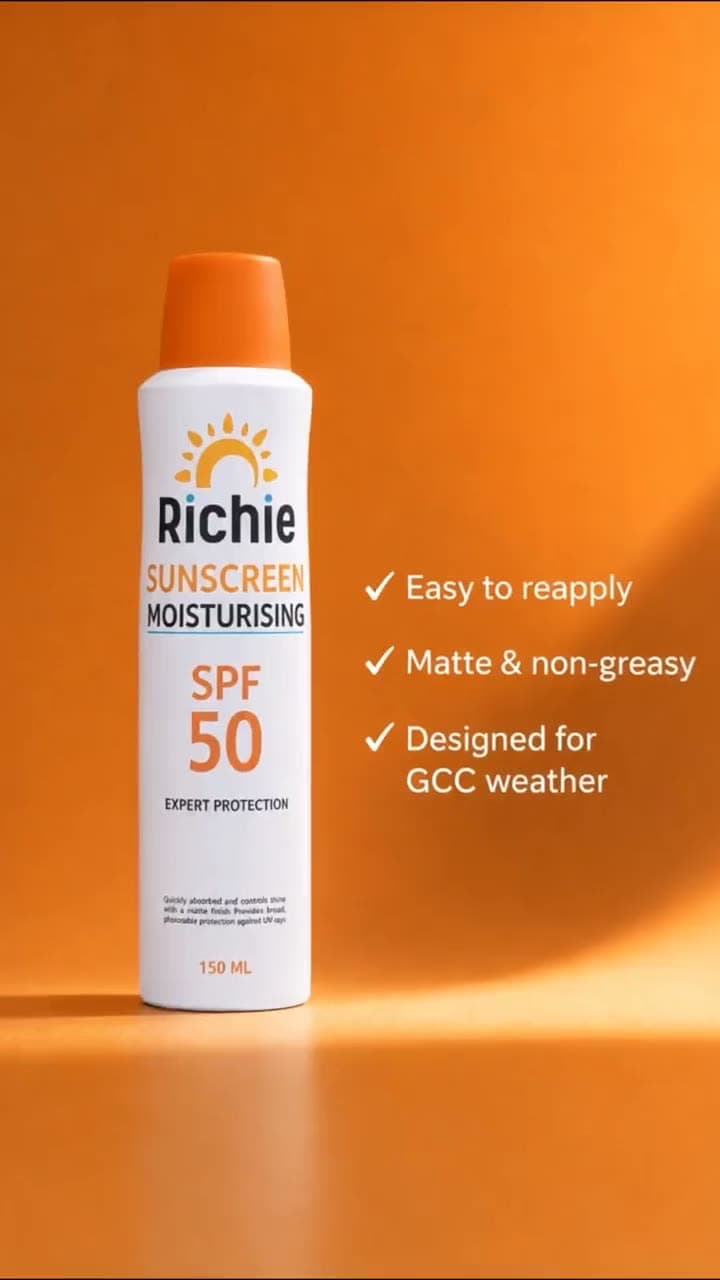
Sunscreen is the biggest opportunity and the biggest claims trap. The SPF number on screen must match the pack and the market's registration. "All-day protection" is a red flag for both platforms and regulators, because sunscreen needs reapplying, especially in heat and after sweating or swimming.
Good AI SPF ads show reapplication made easy: a stick in a handbag, a spray over makeup at the office, a tinted formula with no white cast on deeper skin tones. Show real finishes on real skin across a range of tones, because cast is the first thing GCC shoppers check.
Halal and clean beauty claims
Halal-certified skincare matters to a large share of Gulf and wider Muslim-majority audiences. If your product is certified, show the certification mark and name the certifier in the caption or landing page. If it isn't certified, don't imply it with crescent motifs or "halal-friendly" language.
"Clean beauty" has no single legal definition, so define it in your ad: "free from fragrance," "vegan formula," "no mineral oil." Specific beats vague, and specific claims are easier to substantiate.
Seasonal moments
Plan creative around the calendar your audience lives by: Ramadan and Eid (routines adjusted to fasting, late nights and suhoor), summer travel, back-to-school, the National Day period and the year-end sale season. AI is ideal for seasonal re-skins, swapping settings, colors and supers on proven concepts without a new shoot. Ramadan creative needs a culturally fluent eye on wardrobe, timing and tone, so a human reviewer from the region should approve it.
Arabic and English Variants That Feel Native
Subtitling an English ad is not localization. Arabic-speaking audiences notice immediately when the voice, the script and the on-screen text were built for someone else.
What we do for bilingual skincare campaigns:
- Write in Arabic first for Arabic ads. Translate the idea, not the sentence. Hooks that work in English often fall flat when translated literally.
- Choose the dialect. Gulf Arabic for UAE and Saudi social ads, Modern Standard Arabic for formal or pan-Arab placements. A mismatch makes an ad feel imported.
- Design for right-to-left. On-screen text, step numbers and arrows need to flow the other way. Leave safe zones on both sides for platform UI.
- Match voice and lip-sync. AI voice and dubbing tools make Arabic voiceover fast, but a native speaker should check pronunciation of ingredient names and brand terms.
- Keep claims identical. The Arabic version can't promise more than the English one. Run both through the same claims checklist.
- Test separately. Run Arabic and English as separate ad sets or clearly split creatives, so you learn which language and which hook wins for each audience.
A Production Workflow for AI Skincare Ads
Here is the workflow we run with a human creative team at every step. It gets a skincare brand from brief to a tested set of ads quickly without skipping the review gates that keep you out of trouble.
- Build the claims file. List every claim you're allowed to make, with its source: study, trial, ingredient fact or registration. This is the one document everyone, including the AI prompts, works from.
- Collect real assets. High-resolution packshots from every angle, real texture clips (even phone footage), the exact label artwork, brand fonts and colors, and any real customer or professional footage you have rights to.
- Write the concept matrix. Choose 3-5 angles (for example, "humidity-proof finish," "routine in three steps," "SPF you'll actually reapply") and pair each with 3-5 hooks. That gives you 9-25 starting concepts.
- Script and storyboard. Mark every shot as AI, real or hybrid. Results, experts and application shots are real. Texture, setting, ingredient visuals and transitions can be AI.
- Generate and edit. Produce the AI shots, then cut them with the real footage. Overlay the real label in post rather than trusting a model to render small text.
- Claims and brand review. Run the checklist above. Check every frame of skin, every super and every caption. Fix the pack, the SPF number and the ingredient spelling.
- Localize. Build Arabic and English versions, with native review of script, voice and on-screen text.
- Version for placements. Export 9:16 for Reels, Stories, TikTok and Shorts, 4:5 for the Meta feed and 1:1 where needed, each with its own safe zones and captions.
- Launch the test. Load the variants into a structured test (next section), with disclosure labels applied where required.
- Feed the results back. Winning hooks and angles go into the next round of the concept matrix.
Cost depends on how many concepts and variants you need, how much real footage is involved, the number of languages, and whether a qualified professional is part of the script. Those drivers matter more than the tool, which is why we quote per project.
Creative Testing and Refresh Cadence
AI's real advantage in skincare isn't one beautiful ad. It's the ability to feed the platforms enough distinct concepts to find a winner, then refresh it before performance fades.
How to structure the first test
Test one variable at a time where you can. Start with the angle (what the ad is about), then the hook (the first two seconds), then the format and finally the details such as music, captions and CTA.
A practical first round for a skincare launch on Meta or TikTok:
- 3-5 angles, each with 3 hooks, in one or two formats.
- Equal budget per concept until each has enough spend to judge, for example a daily budget per ad set that lets each ad reach a few thousand impressions within the first week.
- Judge early on hook rate (3-second views over impressions) and hold rate, then on click-through and cost per purchase once the data is there.
We go deeper on budgets, sample sizes and kill rules in our ad creative testing framework.
When to refresh
Skincare audiences are relatively small and see the same brands repeatedly, so winning ads wear out. Watch for rising frequency, a falling hook rate and climbing cost per purchase on an ad whose targeting hasn't changed. Those are the classic signs of creative fatigue.
A cadence that works for many skincare accounts:
- Weekly: What to ship: 3-5 new hooks on proven concepts; Why: Cheapest way to extend a winner
- Every 2-4 weeks: What to ship: 1-2 new angles or formats; Why: Find the next winner before the current one fades
- Seasonally: What to ship: Re-skins for Ramadan, summer, sale periods; Why: Relevance without rebuilding the concept
- Quarterly: What to ship: A fresh real-footage shoot; Why: New real application, customer and expert footage for AI to build around
Adjust to your spend. A brand spending heavily on a single hero SKU will need faster refreshes than a brand rotating a broad catalog.
When Not to Use AI for Skincare Ads
We use AI heavily, and we still tell clients to skip it in these cases:
- Results and before/after. Always real, always consented, always matched lighting. No exceptions.
- Expert endorsement. If a dermatologist, pharmacist or aesthetician is the message, film the real person.
- Shade and tone matching. Tinted SPF, concealer-adjacent products and anything sold on "no white cast" need real skin across real tones.
- Sensitive conditions. Eczema, rosacea, acne and pigmentation content needs real people, careful language and often a medical review. AI personas here feel exploitative and attract policy flags.
- Hero brand films. For a launch film that defines the brand for years, a crafted shoot (often with AI-assisted post) usually beats a fully generated piece.
- When your claims file is empty. If you don't know what you can legally say, no amount of production quality will fix the ad. Build the claims file first.
The pattern is consistent: AI owns the product world, and real people own the evidence.
Frequently Asked Questions
Can AI video ads show before and after results for skincare?
No. An AI-generated or AI-altered before/after is a fabricated result, and platforms and regulators treat it as misleading. If you want to show results, use real, unretouched footage of a real person with their consent, consistent lighting and an honest timeframe. Back any number with a real study or trial, and use AI only for the product shots and transitions around that real footage.
Is AI UGC allowed in skincare ads?
Yes, as long as the AI presenter talks about experience and routine, never personal results, and you follow each platform's disclosure rules for realistic AI-generated people. "This fits into my gym bag" is fine. "This cleared my acne" is a fabricated testimonial. Keep every line in the script tied to your claims file and label synthetic presenters wherever a viewer could take them for a real customer.
Which AI video ad formats work best for skincare brands?
Texture macros, ingredient stories, routine demos, AI UGC hook tests, climate problem-solvers and clean packshot cuts carry most skincare budgets. Texture macros and AI UGC are strong for cold audiences, routine demos and ingredient stories help consideration, and packshot cuts suit retargeting. Dermatologist-style explainers convert well too, but only with a real, qualified professional on camera.
How often should skincare brands refresh their AI video ads?
A good starting rhythm is new hooks every week on proven concepts, one or two new angles every two to four weeks, seasonal re-skins for Ramadan, summer and sale periods, and a quarterly real-footage shoot. Refresh sooner if frequency rises while hook rate and cost per purchase get worse on the same targeting, because those are the signs your audience is tired of the ad.
Do skincare ads in the UAE need Arabic versions?
For most UAE and Saudi campaigns, yes. Bilingual audiences respond better to ads written natively in Arabic, in the right dialect, with right-to-left on-screen text. Write the Arabic script from the idea rather than translating the English line by line, have a native speaker check ingredient and brand pronunciation, keep claims identical across languages, and test the Arabic and English versions separately.
How do you keep AI skincare ads compliant with Meta and TikTok policies?
Work from a claims file, never show AI-made skin as a result, avoid fake experts, match the label and SPF figure to the real pack, and don't write hooks that assume the viewer has a condition. Apply AI disclosure labels where required, and run every variant, including Arabic versions, through the same review before launch. Building the script from approved claims removes the most common cause of rejections.
Work With XMA on Your Skincare Ads
We make AI video ads for beauty and personal-care brands across the UAE, the GCC and global markets, with a human creative team on strategy, scripting, claims review, Arabic localization and testing. You get the speed and variant volume of AI, and the judgment to know which shots must stay real.
If you're planning a launch, a summer SPF push or a Ramadan campaign, tell us your products, markets and timeline. Get a quote and book a strategy call with XMA and we'll come back with a concept plan for your first test.