AI vs Traditional Video Production: A Buyer's Guide to Choosing the Right Route (2026)

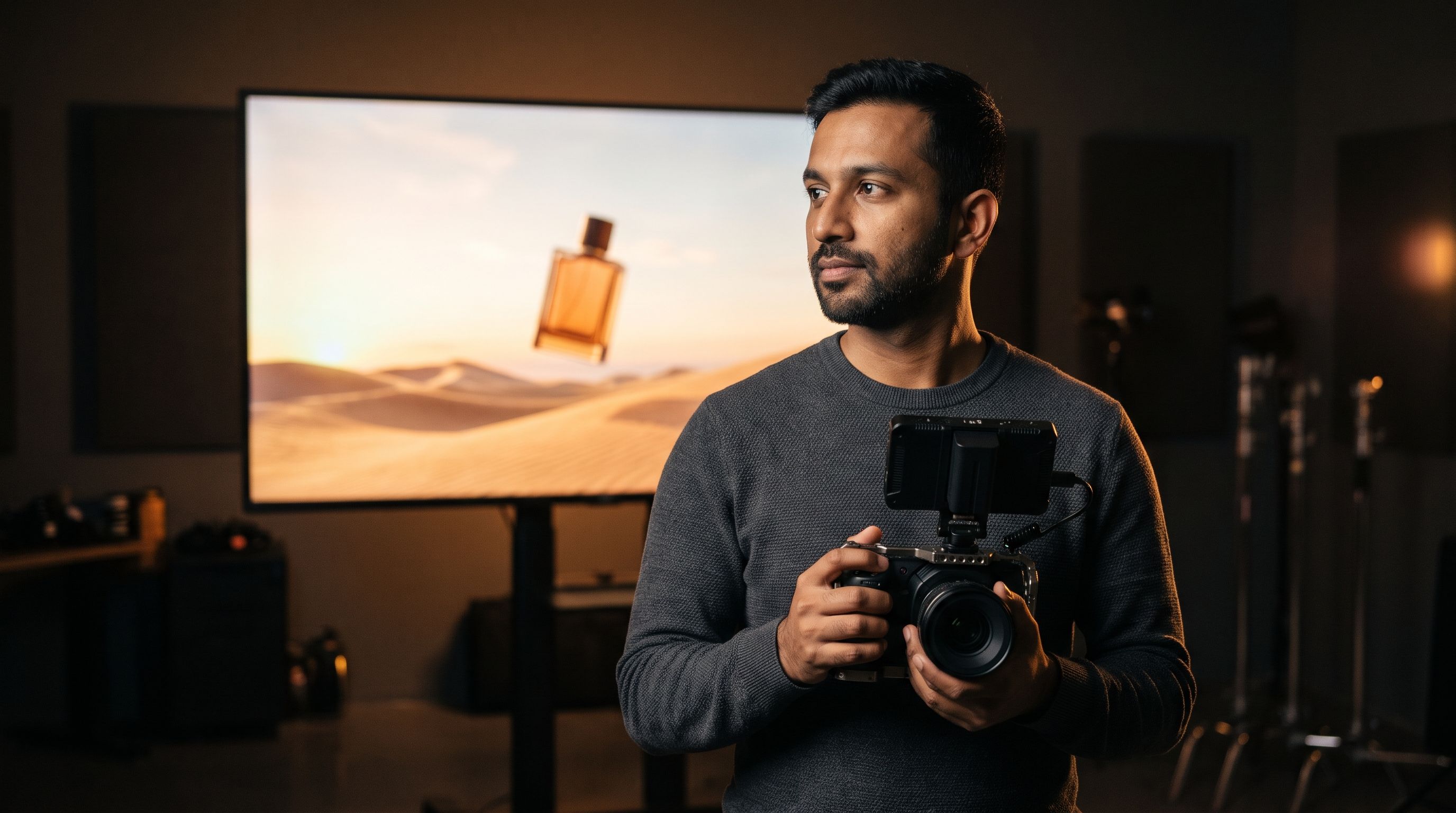
In the AI vs traditional video production decision, there is no universal winner. AI wins when you need speed and many ad variants. A traditional shoot wins when buyers must trust a real face, a real place or an exact product. For most brands running paid social, a hybrid of both does better than either one alone.
This guide is for the moment just before you brief someone. You will get a side-by-side comparison across six criteria, the honest cases where AI still loses, what drives cost in each route (without made-up price ranges), a "choose AI if / traditional if / hybrid if" matrix, and a rights and disclosure checklist. We make both kinds of video for brands in Dubai and globally, so we have no reason to push you toward one.
In this guide
- What Each Route Means in 2026
- AI, Traditional and Hybrid Side by Side
- Honest Trade-Offs: Where Each Route Loses
- The Hybrid Model: AI Plus a Creative Team
- What Drives Cost in Each Route
- Choose AI If, Traditional If, Hybrid If
- Brand Safety, Disclosure and Rights
- How to Run Your First Comparison Test
- Frequently Asked Questions
- Ready to Pick Your Route?
What Each Route Means in 2026
The words get used loosely, so here is what we mean by each.
Traditional video production is a camera shoot: a script, a crew, talent, a location, lighting, then editing, color and sound. Everything on screen existed in front of a lens. If you want the full picture of how a shoot runs, our walkthrough of the video production process for ads covers all ten stages.
AI video production generates footage with models instead of a camera. A team writes the script, builds reference images, generates shots, then edits and finishes them. Many AI ads start from a still product photo and animate it, which our explainer on what AI image-to-video is breaks down step by step.
Hybrid production mixes the two inside one campaign or even one ad. A real presenter might be filmed once, while AI handles the scenes a camera can't reach cheaply: a product floating in a desert at sunrise, ten background swaps, or a version for every audience. This is how we work at XMA. Our AI video production service and our filmed video production team sit in the same studio, and we choose per project.
One thing that has not changed: in all three routes, the idea, the script and the edit decide whether the ad sells. Tools change the cost of making shots, not the cost of having nothing to say.
AI, Traditional and Hybrid Side by Side
The table below compares the three routes on the six criteria buyers ask us about most. These are working patterns from our own projects, not industry statistics.
Speed is the headline, but variant volume is the real reason performance teams switch. On Meta and TikTok the algorithm needs fresh creative, and a single filmed ad fatigues fast. If a winning angle can be remixed into ten hooks in a week, you learn faster. We explain that pressure in more depth in our piece on whether TikTok ads are worth it for your business.
Honest Trade-Offs: Where Each Route Loses
Every route has failure points. Knowing them before you brief is cheaper than discovering them in a review round.
Where AI loses: faces in close-up
Faces are the hardest thing for video models. Wide and medium shots of people now look natural, but tight close-ups that hold for several seconds can show odd blinks, teeth that shift, or skin that looks too smooth. Viewers read faces closely, and a slightly wrong face costs trust. If your ad depends on a founder speaking straight to camera, film it.
Where AI loses: exact product accuracy
Models like to "improve" things. A bottle cap changes shape, a logo bends, a label gets extra letters, a ring gains a stone. For a fragrance, jewelry or skincare brand, that is not a small error: the ad must show what the customer will receive. We reduce this by starting every film from the brand's real product photos and locking the product before building any scene. Still, products with fine engraving, transparent liquids or complex mechanisms often need a real camera for the hero shot.
Where AI loses: legal and regulated claims
If your ad makes a claim that must be provable, such as a before-and-after result, a clinical outcome, a real customer testimonial or a property you are selling, generated footage can mislead even when you don't mean it to. A synthetic "before and after" is not evidence. Health, beauty, finance and real estate brands in the UAE should keep proof-based scenes real and documented. Our video ads for cosmetics brands are built on that rule: we describe what the product is and how it's used, and limit result claims to what the brand is allowed to say.
Where AI loses: real places, real events and real people
A launch event, your actual showroom on Sheikh Zayed Road, your team at work: generated versions of these are fiction. If the point is "this is really us," AI defeats the purpose.
Where traditional production loses: volume and change
A shoot captures one moment. Once the crew leaves, every new idea costs another shoot day. If testing shows that the third hook works best, you can only re-cut what you filmed. Traditional production also struggles with scenes that are expensive or impossible to stage: a perfume bottle in a rainstorm over the desert, a product that turns into its ingredients, or a set in five countries. Our guide to AI video effects that sell shows which of those effects help an ad and which backfire.
Where traditional production loses: time to market
Booking crew, talent and location in Dubai takes time, especially in peak season before Ramadan, Eid and White Friday. If a trend or a competitor move needs a reply this week, a shoot calendar can't keep up.
The Hybrid Model: AI Plus a Creative Team
Hybrid is not "use a bit of each and hope." It is a division of labor: the camera covers what must be true, and AI covers what must be many.
Here is a typical split we use for a product launch:
- Film the trust layer. A real presenter, real hands holding the product, the real store or kitchen. One planned shoot day, structured around the ads you need.
- Generate the reach layer. AI scenes, backgrounds, seasonal versions, alternate openings and product hero shots built from approved photos.
- Edit into a test batch. Several hooks on the same body, cut to each placement's format.
- Version for language. Arabic versions written in Arabic from the start, not dubbed from English. Our Arabic-first production team chooses Gulf, Levantine or Modern Standard Arabic based on the buyer's market.
- Let results pick the winner, then make more of what works.
A real example of why mixing matters: in our skincare brand launch case, the campaign combined before-and-after images, premium product films, social proof and AI-made creator-style videos. The brand received more than a hundred orders in its first months, and about two in three of those came from one AI-made creator-style video. The same launch was also built on real product photography across the full range. That page notes past results are not a promise, and we'd say the same here.
The creative team matters as much as the tools. Someone has to write hooks for the buyer, judge whether a face looks right, catch a warped label, and decide that a shot needs a camera after all. Our article on using AI to improve video quality shows the kind of frame-by-frame checking that separates a usable AI ad from a rejected one.
What Drives Cost in Each Route
We don't publish market price ranges in this guide, because they swing so widely by scope that any number would mislead you. What we can do is show you the levers. Once you know them, you can compare quotes on the same basis.
The table below lists the main cost drivers for each route.
Two things often surprise buyers. First, AI does not make every film cheap. A long hero film with recurring characters, many close-ups and precise motion can take more work than a simple shoot. Long single takes are also hard: our guide on how to make AI videos longer explains why clips are chained and stitched. Second, a shoot gets much better value when it is planned to produce many cuts. The question isn't "which route is cheaper" but "which route gives us more usable, tested ads for the budget." When you're ready to compare like for like, get a quote for your next campaign and we'll scope all three routes.
Choose AI If, Traditional If, Hybrid If
Use this matrix as a first filter. Find the row that describes your next project, then read across.
If you fall between two rows, start with the more conservative route for hero assets and the faster route for testing assets. That way a weak AI shot can never be the only thing representing your brand.
For corporate and internal video, the trade-offs shift again: trust and real people usually matter more than volume. Our guide on what corporate video production is covers those formats and their ideal lengths.
Brand Safety, Disclosure and Rights
This is the part most comparisons skip, and it is where AI projects go wrong after delivery. Run through this checklist before you approve any route.
- Disclose AI content where the platform asks. TikTok asks creators to label realistic AI-generated content, as explained in its guidance on AI-generated content. Meta also adds AI labels in some cases, as set out in its AI disclosure policy on the Meta Transparency Center. Plan for labels; don't try to dodge them.
- Don't fake a real person. Never generate a celebrity, a public figure or a real customer without written consent. AI presenters should be clearly synthetic or licensed.
- Keep claims provable. Before-and-after scenes, clinical claims and testimonials must be real and documented.
- Check the product in every frame. Logo, label, cap, color and size must match what ships. One warped label in one variant is enough to cause a complaint.
- Ask who owns what. For a shoot, check talent usage terms (how long, which countries, which channels) and music licences. For AI, ask whether you get the finished films, working files and source projects. At XMA, once a period is paid, the client owns the finished film, working files, raw footage and source projects, with no buy-out.
- Agree revision rounds up front. Our AI films include two revision rounds each. Whatever partner you choose, get the number in writing.
- Confirm sign-off before launch. Nothing should go live without your written approval.
Want more real-world context on how brands have used AI, including the ads that backfired? Our breakdown of AI in advertising examples covers both.
How to Run Your First Comparison Test
If you are still unsure, test instead of guessing. Ad results will tell you which route works for your product and audience. Here is a simple plan.
- Pick one product and one offer. Keep everything else constant so the creative is the only variable.
- Brief one angle three ways: an AI version, a filmed version and a hybrid version with the same hook and script.
- Make several hooks for each. Three openings per version gives the platform enough to work with.
- Launch on the same campaign setup. Same audience, same budget split, same placements.
- Judge on the metric that pays the bills, such as cost per purchase or cost per lead, not on views alone.
- Scale the winner and kill the losers, then make new versions of the winning route.
Our published seven-step process follows this rhythm: scripts in 3 to 5 business days, then 5 to 7 business days to make five ads, then launch and weekly improvements. If you're weighing whether to run a test like this yourself or hand it to a partner, our sibling guide on marketing agency vs in-house lays out that choice.
Frequently Asked Questions
Is AI video production better than traditional video production?
Neither is better in every case. AI is faster and makes many variants for testing, which suits paid social. Traditional production is better for close-up faces, exact products, real places and provable claims. Most brands that run ads every month get the best results from a hybrid: film the scenes that need to be real, then use AI to scale versions and test hooks quickly.
Can AI video look as real as a camera shoot?
For products, scenes and wide shots of people, AI can look very close to filmed footage, especially on a phone screen. It still struggles with faces held in tight close-up, fine product details like engraving or clear liquids, and long continuous motion. On large screens these flaws are easier to spot, so we film hero shots and flagship brand films when realism must be perfect.
When should a brand not use AI video?
Avoid AI for anything that must be literally true: real testimonials, before-and-after results, clinical or financial claims, real properties, your actual team, and live events. Skip it as well when a founder or expert needs to speak in close-up to build trust. In those cases a real camera protects your credibility and keeps your ads within platform and advertising rules.
What does a hybrid AI and traditional production look like?
A hybrid project films the trust layer once, such as a presenter, real hands with the product or your real store. AI then builds the reach layer: new scenes, backgrounds, seasonal versions and alternate hooks, often from approved product photos. Editors cut both into a test batch for each platform, and Arabic versions are written natively. The result is real where it counts and plentiful where volume matters.
Do I need to label AI-generated video ads?
Often, yes. TikTok asks creators to label realistic AI-generated content, and Meta applies AI labels in some cases under its disclosure policy. Rules change, so check each platform's current guidance before launch. Labelling rarely hurts a good ad. Hiding AI use and being found out does far more damage to trust than an honest label ever will.
Who owns AI-generated video made by an agency?
It depends on the contract, so ask before you sign. Check whether you receive the finished films, working files and source projects, and whether any AI presenter or voice is licensed for your channels and countries. At XMA, once a period is paid, the client owns the finished film, working files, raw footage and source projects. Always get ownership terms in writing.
Ready to Pick Your Route?
The right choice depends on what your ad must prove and how many versions you need to test. If you need trust, film it. If you need volume, generate it. If you need both, and most growing brands do, combine them with a team that can judge each shot honestly.
We make AI, filmed and hybrid ads in Dubai for brands across the UAE and globally, in English and Arabic. Book a strategy call and tell us about your next campaign. We'll tell you which route fits, including when it's not the AI one.