What are short form video ads?
A short form video ad is a paid video placement shown in a full-screen, swipeable feed. The viewer did not search for it and can swipe it away at any moment, so the ad has to earn attention the way organic content does.
Three things separate them from classic video ads:
- Vertical and full screen. The standard canvas is 9:16 at 1080 x 1920 pixels. A horizontal TV spot dropped into a Reels placement shrinks into a small box and gets skipped.
- Native style. The strongest ads look like a creator or customer talking to camera, not like a studio commercial. Google's Creative Works team analysed more than 2,000 YouTube Shorts ads and found the best performers were "Shorts-first": casual, conversational and built for the feed (Think with Google).
- Built to be replaced. A short form ad has a shelf life measured in days or weeks. You plan for a steady supply of new versions, not one hero film.
Short form video ads vs long form video ads
- Typical length: Short form video ads: 6-60 seconds; Long form video ads: 60 seconds to several minutes
- Aspect ratio: Short form video ads: 9:16 vertical; Long form video ads: 16:9 horizontal, sometimes 1:1
- Where they run: Short form video ads: TikTok, Reels, Shorts, Stories, Snapchat; Long form video ads: YouTube in-stream, CTV, websites
- Viewer mindset: Short form video ads: Scrolling, can swipe away instantly; Long form video ads: Watching, often waiting to skip
- Job in the funnel: Short form video ads: Stop the scroll, create demand, drive an action; Long form video ads: Explain, build trust, support big decisions
- Production style: Short form video ads: Creator-style, fast, many variants; Long form video ads: Polished, fewer versions
- Refresh cycle: Short form video ads: Weekly to monthly; Long form video ads: Months
Most brands need both. Long form carries the story; short form finds the audience and sends them to act.
Why short form video ads work (and when they don't)
Short form ads work for four practical reasons:
- The placements are where attention is. Reels, TikTok and Shorts are where people spend their scrolling time every day, and advertisers have moved a growing share of their video budgets into these feeds to follow them.
- The algorithm does the targeting. On TikTok and Meta, the creative itself tells the platform who to show the ad to. A clear hook for "busy mums in Dubai" finds busy mums in Dubai faster than any interest setting.
- Testing is cheap. You can learn which message sells from a few hundred dirhams of spend per variant, then scale the winner.
- Production can be fast. A short ad does not need a crew, a location and a two-week edit, especially with AI in the workflow.
They are not the right tool for everything. A complex B2B service, a high-ticket property sale or a product that needs a detailed demo usually needs long form or a landing page to close. In those cases, use short form ads to earn the click or the lead, and let other content do the explaining.
Where to run short form video ads: platform guide
Every major platform now has a short form placement. The specs are close enough that one 9:16 master file can serve all of them, as long as you respect each platform's interface.
- TikTok: Placement: In-feed ads, Spark Ads; Aspect ratio: 9:16; Resolution: 1080 x 1920; Practical ad length: 15-45 seconds
- Instagram: Placement: Reels and Stories ads; Aspect ratio: 9:16; Resolution: 1080 x 1920; Practical ad length: 15-30 seconds
- Facebook: Placement: Reels ads; Aspect ratio: 9:16; Resolution: 1080 x 1920; Practical ad length: 15-30 seconds
- YouTube: Placement: Shorts ads; Aspect ratio: 9:16; Resolution: 1080 x 1920; Practical ad length: 15-60 seconds
- Snapchat: Placement: Single video ads; Aspect ratio: 9:16; Resolution: 1080 x 1920; Practical ad length: 6-15 seconds
The practical lengths above are the ranges we see work in campaigns, not hard platform limits. Each platform allows longer uploads.
Safe zones and sound
The feed interface covers part of your video. The caption, username and CTA button sit at the bottom, and the like, comment and share icons run down the right side. Keep faces, product shots, prices and on-screen text in the central area of the frame, and leave the bottom fifth and the right edge clear.
On sound: TikTok is watched mostly with sound on, so voiceover, music and trending audio carry the message. On Meta, many people watch muted, so every ad needs burned-in captions or on-screen text that tells the story without audio. Build for both: a voiceover plus captions.
The anatomy of a short form video ad, second by second
Almost every winning short form ad follows the same three-part structure. We cover the platform differences in more depth in our hook, body and CTA framework for Meta and TikTok, but the basics look like this.
The hook (0-3 seconds)
The hook decides whether anyone sees the rest. It needs to do one of these in the first second or two:
- Call out the viewer: "If you run a skincare brand in the UAE, stop scrolling."
- Show the result first: the finished glow, the full plate, the before and after.
- Make a bold or surprising claim you can back up.
- Start mid-action: hands opening the box, the perfume spraying, the car door closing.
Put a text hook on screen at the same time as the spoken one, for muted viewers. Never open on a logo.
The body (3-20 seconds)
The body turns attention into desire. Show the product in use, name the one problem it solves, and add one proof point: a review, a number, a demonstration. Cut every two to three seconds to keep the pace, but let the key product moment breathe. One message per ad. If you have three benefits, make three ads.
The call to action (last 3-5 seconds)
Tell people exactly what to do and why now: "Tap Shop Now, free delivery in Dubai today" beats "Learn more". Repeat the CTA in text and voice, and show the product one last time.
A 20-second example script
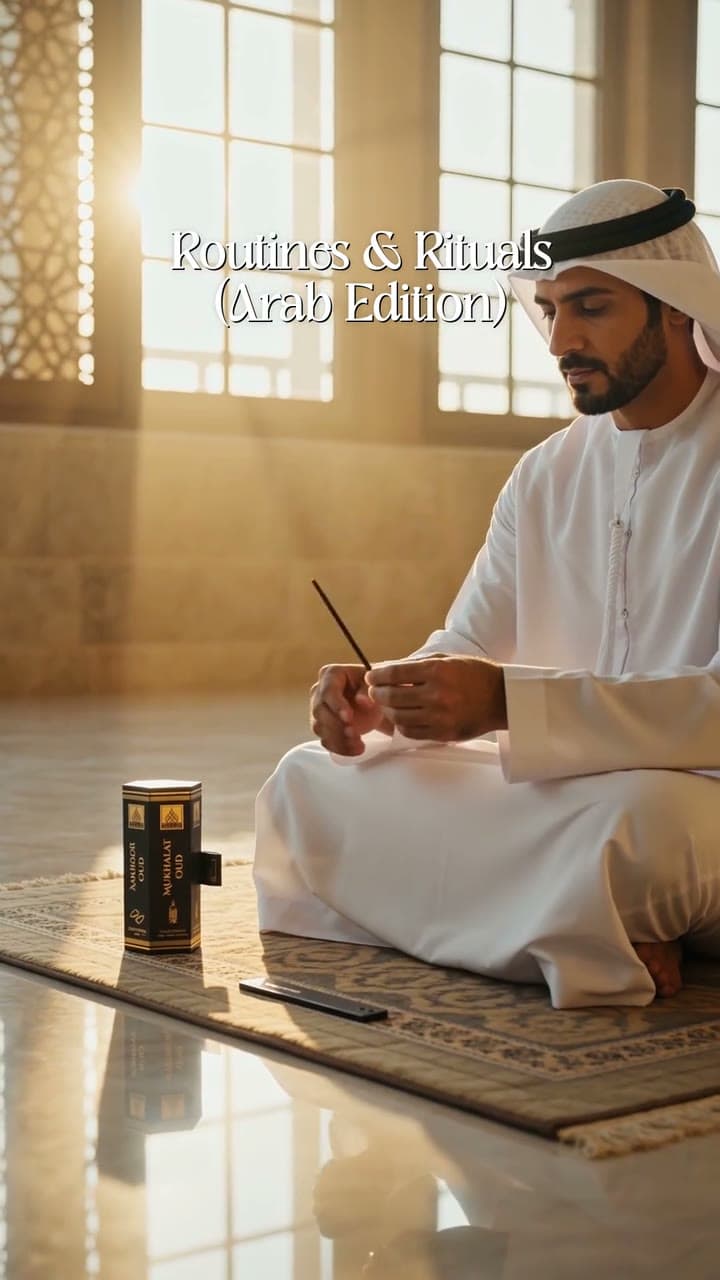
- 0-2s: Close-up of oud smoke rising, text: "The scent people ask about."
- 2-8s: Creator applies the perfume, compliments start arriving on their phone.
- 8-15s: Product close-up, notes listed on screen, "lasts 12 hours" demonstrated with a time-lapse.
- 15-20s: "Order today, delivered tomorrow across the UAE", with the bottle and price on screen.
8 short form video ad formats that convert
You do not need to reinvent the idea every time. These formats cover most of what works. You can see several of them in our AI video portfolio.
1. UGC testimonial
A customer or creator talks to camera about their experience. It is the most reliable format on TikTok and Reels because it looks like a friend's recommendation. Our guide to what a UGC creator does covers how brands brief and pay for this content.
2. Problem and solution
Open on the frustration (frizzy hair in Dubai humidity), then show the product fixing it. Simple, and very effective for products with a clear "before".
3. Product demo
Show exactly how it works in 15 seconds. Best for gadgets, beauty tools, kitchen products and apps.
4. Unboxing
The reveal, the packaging and the first reaction. Works especially well for premium categories like fragrance, jewelry and gifting.
5. Before and after
A split screen or a quick transformation. Check each platform's policy first, because health and beauty claims are restricted.
6. Founder or team story
The person behind the brand explains why they made it. It builds trust for new brands and local businesses.
7. CGI and 3D product ads
Physically impossible shots: the bottle floating through a desert storm, the watch assembling itself. With AI and 3D tools these are now affordable, and they stop the scroll because they look unlike anything else in the feed.
8. Comparison
Your product next to the usual alternative, with one clear point of difference. Keep it factual and avoid naming competitors unless you have legal sign-off.
How long should a short form video ad be?
There is no single right length. Match it to the job:
- 6-10 seconds: awareness and retargeting. One idea, one image, logo at the end. Good for Snapchat and as YouTube bumper-style cutdowns.
- 15-30 seconds: the default for conversion ads on Reels and TikTok. Enough time for a hook, one proof point and a CTA.
- 30-60 seconds: UGC testimonials, demos and offers that need explaining. Only if the pace holds. If the hold rate drops sharply after 15 seconds, cut it down.
A good habit is to make one 30-second master and cut 15-second and 6-second versions from the same footage. You get three tests from one production.
How to make short form video ads: a step-by-step process
This is the process we follow from brief to launch. For our clients it takes about seven days.
- Set one objective per ad. Sales, leads, app installs or awareness. The objective decides the hook, length and CTA.
- Write the brief. Audience, the single problem you solve, the proof you have, the offer, the mandatory brand elements, and the markets (UAE only, GCC, or global).
- Write three to five hooks per concept. Hooks are the cheapest thing to test and the biggest driver of results.
- Script and storyboard. Keep scripts under 70 words for a 30-second ad. Mark where text overlays and product shots go.
- Produce. Film with creators, generate scenes with AI, or combine both. Shoot vertically from the start; cropping a horizontal shoot loses detail.
- Edit for the feed. Hook in the first second, captions burned in, safe zones respected, sound mixed for phones.
- Make the variants. Swap hooks, CTAs, lengths and languages to build a test set of 5 to 15 ads.
- Launch, read the data, iterate. Kill losers early, scale winners, and brief the next round from what the numbers say.
Doing it with AI: what changes
AI mostly changes steps 5 and 7. Scenes, product shots, voiceovers and translations that used to need a shoot can now be generated, which makes a set of 10 variants about as affordable as one used to be. Our roundup of the best AI video generators for ads covers the tools we tested on real campaigns.
Where AI still falls short: real people trying a real product, exact product details like labels and textures, and any claim that must be literally true on screen. Most of our strongest ads combine AI-generated scenes with real product footage and a human creative team deciding what to make.
Label AI-generated content where the platform asks you to. TikTok requires AI-generated content to be labeled, and Meta adds "AI info" labels to some AI-made media. Hiding it can get ads rejected.
How much do short form video ads cost to produce?
Costs vary a lot by market and quality. These are typical ranges we see, as a guide rather than a quote:
- DIY with your phone and an editing app: Typical cost per finished ad: Your time; Turnaround: 1-3 days; Best for: Testing ideas, very small budgets
- UGC creator: Typical cost per finished ad: From about USD 300 (AED 1,100); Turnaround: 3-7 days; Best for: Authentic testimonials and demos
- Traditional production studio: Typical cost per finished ad: AED 30,000-80,000 for a produced video; Turnaround: 2-4 weeks; Best for: Hero brand films, TV-quality spots
- AI production with a creative team: Typical cost per finished ad: A fraction of a studio shoot, with extra variants at low cost; Turnaround: About 7 days; Best for: Testing at volume, CGI, multilingual versions
The UGC figure comes from our research on UGC creator rates, and the studio range from our review of Dubai production houses. For a fuller breakdown of AI production pricing in the UAE, see our guide to AI video production in Dubai.
The number that matters is cost per winning ad, not cost per ad. If one studio film costs the same as 20 tested variants and only the variants reveal which message sells, the cheaper route is also the one with better results.
Testing and creative fatigue: how many ads you actually need
Short form ads wear out. The same people see the same ad again, performance drops, and costs rise. This is creative fatigue, and it arrives faster on TikTok than on Meta. On TikTok we plan for fresh creative roughly every 7 to 10 days; Meta ads usually last longer, and frequency is the number to watch.
A workable rhythm for most brands:
- Launch with 5-15 ads per product or offer, spread across two or three concepts with several hooks each.
- Judge hooks after a few thousand impressions. Pause the clear losers.
- Add 3-5 new ads every week or two on TikTok, and at least monthly on Meta.
- Iterate on winners before inventing new concepts. A new hook on a proven body is the fastest win.
This is where production speed turns into profit. Brands that can ship new variants every week keep costs stable; brands that wait a month for the next shoot watch their cost per sale climb.
Metrics that tell you if your ads are working
Views and likes are not the goal. Track these instead:
- Hook rate (3-second views ÷ impressions): What it tells you: Is the opening stopping the scroll?; How to use it: Low: test new first seconds
- Hold rate (views past 15s or ThruPlays ÷ 3-second views): What it tells you: Does the body keep attention?; How to use it: Low: tighten the pace, cut filler
- Click-through rate: What it tells you: Does the ad create enough interest to act?; How to use it: Low: sharpen the offer and CTA
- Cost per result (CPA): What it tells you: What each sale or lead costs; How to use it: The number to optimize against
- ROAS: What it tells you: Revenue for each dirham spent; How to use it: Decides what gets scaled
- Frequency: What it tells you: How often the same person sees the ad; How to use it: Rising with falling CTR means fatigue
Read them in order. A weak CPA with a strong hook rate means the problem is after the click (offer, landing page, checkout), not the video.
Short form video ads in Dubai and the GCC
Most guides are written for the US market. Advertising in the UAE and the Gulf has its own rules:
- Make Arabic and English versions. Many UAE audiences scroll in both languages. An Arabic hook with English captions, or the reverse, often outperforms a single-language ad. Use native Gulf Arabic, not a literal translation.
- Cast and set locally. Recognisable Dubai locations, local creators and Gulf styling build trust faster than generic stock scenes.
- Plan around the calendar. Ramadan, Eid, White Friday, Dubai Shopping Festival and back-to-school shift both costs and viewing habits. Ramadan in particular changes when people scroll, with late evening viewing rising, so schedule creative and budgets for it weeks ahead.
- Check creator permits. If you pay creators in the UAE to promote your brand, check they hold the UAE Media Council advertiser permit where required.
- Respect cultural norms. Modest styling and sensitivity around religious occasions are part of good creative, not a restriction on it.
Common mistakes to avoid
- Opening with a logo or a slow brand intro
- Reusing a horizontal TV ad in vertical placements
- Putting text or the product under the platform's buttons
- No captions, so muted viewers get nothing
- Three messages in one 15-second ad
- Launching one ad and waiting for results instead of testing a set
- Judging ads on likes instead of CPA and ROAS
- Letting winning ads run until they are fully fatigued before replacing them
Frequently Asked Questions
What is a short form video ad?
A short form video ad is a paid vertical video, usually 6 to 60 seconds long, that appears in full-screen feeds such as TikTok, Instagram Reels, Facebook Reels, YouTube Shorts and Snapchat. It is designed to look native to the feed, stop the scroll in the first three seconds, and drive one clear action such as a purchase or a lead.
How long should a short form video ad be?
For most conversion campaigns, 15 to 30 seconds works best on Reels and TikTok. Use 6 to 10 seconds for awareness and retargeting, and go up to 60 seconds only for testimonials or demos that hold attention. The simplest approach is to make a 30-second master and cut shorter versions to test.
What aspect ratio should short form video ads use?
Use 9:16 vertical at 1080 x 1920 pixels. It fills the phone screen on TikTok, Instagram Reels, Facebook Reels, YouTube Shorts and Snapchat. Keep text, faces and products in the center of the frame, away from the bottom caption area and the buttons on the right side.
How much does a short form video ad cost to make in Dubai?
It depends on the route. A UGC creator ad starts from about USD 300 (AED 1,100), a produced video from a traditional Dubai studio typically costs AED 30,000 to 80,000, and AI production with a creative team costs a fraction of a studio shoot while producing many variants for testing.
How many ad variations should I test?
Launch with 5 to 15 ads per product or offer, built from two or three concepts with several hooks each. Pause clear losers after a few thousand impressions, then add three to five new ads every one to two weeks on TikTok and at least monthly on Meta, so that performance does not drop from creative fatigue.
Can AI make short form video ads?
Yes. AI can generate scenes, CGI product shots, voiceovers and translated versions, which makes it affordable to produce and test many variants. It still struggles with real people using real products and exact product details, so the best results come from combining AI with real footage and a human creative team.
Ready to scale your short form video ads?
Short form video ads reward the brands that ship good creative often: a strong hook, one clear message, native style, and a steady flow of new variants to test. If you want that engine without building an in-house studio, our team in Dubai combines AI speed with human creative direction and delivers from brief to launch in about seven days. Book a strategy call with XMA and we will show you what we would test first for your brand.