What Is Social Video? The Format, the Budget Line and How to Build It for Each Platform (2026)

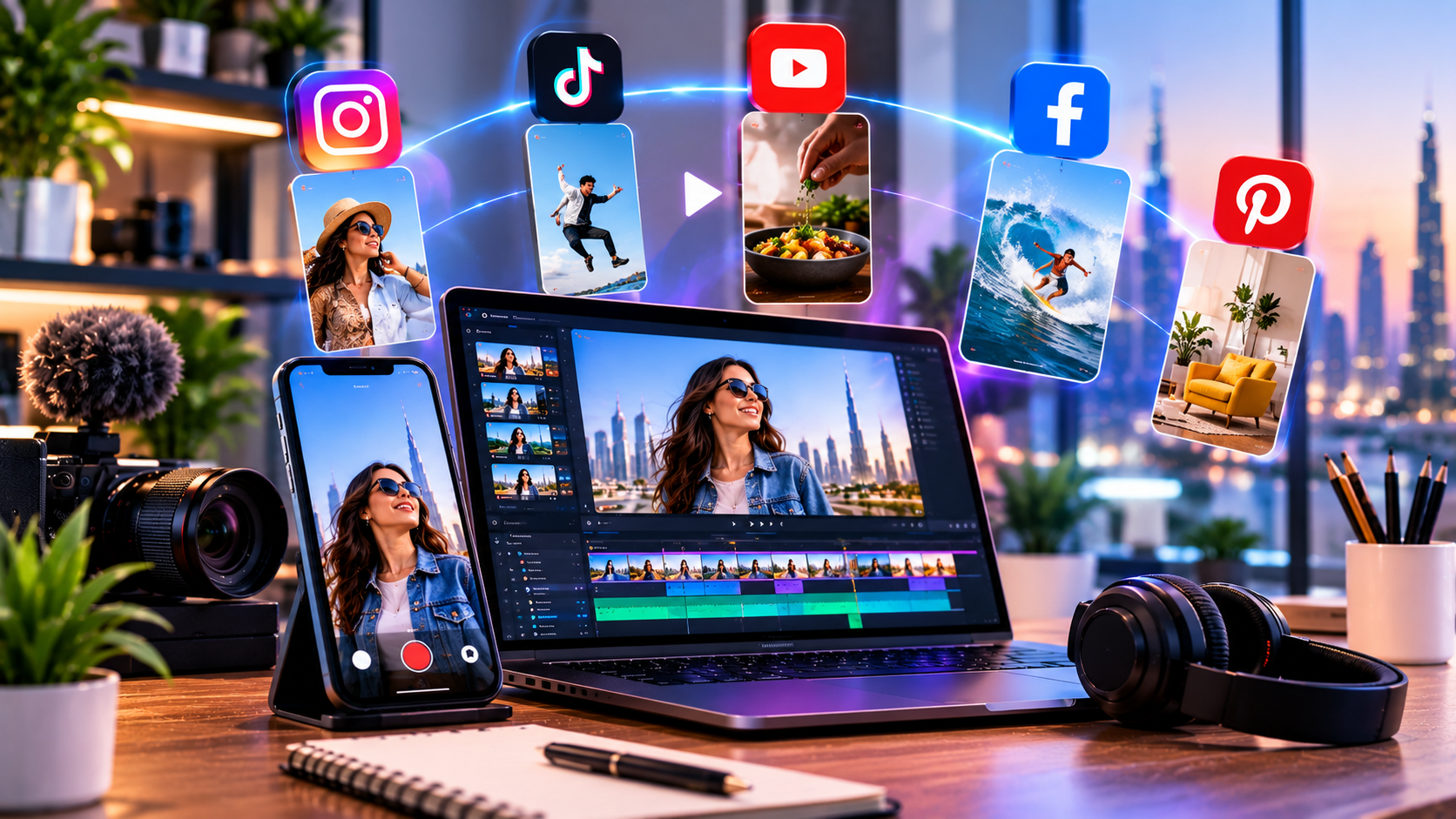
Social video is video made to be watched inside a social feed, such as TikTok, Instagram Reels, YouTube Shorts, Facebook, Snapchat or LinkedIn, by someone who was scrolling and did not choose to press play. It is vertical or near-vertical, short, readable without sound and built to earn attention in the first second. The same term is also a budget line: media teams use "social video" to separate money spent in platform feeds from TV, connected TV and video on publisher websites.
So what is social video in practice? It is a format and a way of buying, and it comes in three forms: organic posts, paid ads and creator-led content. In this guide we explain how it differs from other video, what makes a clip feel native to a feed, how to build one cut per platform, which production route fits, how results are counted, and what changes for brands in Dubai and the wider GCC.
In this guide
- Social video, defined
- How social video differs from TV, online and website video
- The three forms: organic, paid and creator-led
- What makes a video native to a feed
- Building social video platform by platform
- How social video is made: four production routes
- How social video is measured
- Common social video mistakes
- Frequently Asked Questions
- Plan your social video with XMA
Social video, defined
The simplest definition: social video is any video whose main home is a social platform's feed, and which is designed around how people behave there. That second part matters more than the first. A TV commercial uploaded to Instagram is on a social platform, but it is not social video, because nothing about it was built for a thumb, a phone held upright or a viewer with the sound off.
Three things set it apart from other video:
- The viewer did not ask for it. On TV or a streaming service, people choose a show and sit through what plays. In a feed, your video arrives uninvited between a friend's post and a recipe clip. You have about a second to give them a reason to stay.
- The algorithm is the distributor. Each platform decides who sees your video based on how earlier viewers reacted. Watch time, replays, shares, saves and comments tell the system whether to show it to more people.
- The viewer can act at once. They can follow, comment, share, tap through to a product, message you on WhatsApp or book a call without leaving the app. That makes social video both a brand tool and a direct response tool.
Social video as a format
As a format, social video has a recognizable shape. It opens with motion, a face or a bold line of text instead of a logo. It fills the screen vertically. It carries captions or on-screen text so the story survives without audio. It makes one point, then ends or loops. Most clips run from a few seconds to about a minute, although Reels and Shorts now accept longer uploads.
Social video as a budget category
Inside marketing and media teams, "social video" is also a line on the media plan. It covers video ads bought inside the platforms' own tools, such as Meta Ads Manager, TikTok Ads Manager and Google Ads for YouTube. These are bought, priced and measured differently from TV spots or pre-roll on news sites, so planners track them separately. If someone asks you for a "social video budget", they usually mean paid video in feeds, plus the production needed to feed it.
How social video differs from TV, online and website video
People often lump all video together, then wonder why an ad that worked on TV fails on TikTok. The difference is not just length. Where a video plays changes who is watching, what state they are in and how sound behaves.
The table below compares social video with the other main places brand video runs.
The practical lesson: a social video has to win the viewer before it can say anything. TV can afford a slow open because the viewer is waiting for their show to come back. A feed gives you no such patience. Website video sits at the other end, where the visitor already clicked and wants detail, which is why we treat a landing page video as a closer, not an opener.
Why the split matters for your plan
Because each type serves a different viewer state, one master edit rarely works everywhere. A sensible plan shoots or generates once, then cuts versions for each job. The 30-second brand film can live on YouTube and connected TV. The 9-second vertical cut with a text hook runs in Reels and TikTok. The 60-second demo sits on the product page. Same story, different builds.
The three forms: organic, paid and creator-led
Social video is not one activity. Brands use it in three ways, and the creative rules shift with each. If you want the deeper strategic view on balancing effort between the first two, we cover it in our guide to how paid and organic social feed each other.
This table sets the three forms side by side.
Organic social video
Organic video is what you post to your own profile without paying to promote it. Its reach depends on how well it holds viewers and how often you post. It is where you test ideas cheaply, build a recognizable voice and answer the questions customers keep asking. It rarely drives sales on its own at the start, but it gives your paid ads a profile worth visiting.
Paid social video
Paid social video is an ad. You choose an objective, an audience and a budget, and the platform's auction decides who sees it. The creative still has to look and feel native, because people skip anything that smells like an interruption. The big difference is control: you can target, test several versions at once and scale the winner. The auction rewards ads that people watch, so weak creative costs more to deliver.
Creator-led social video
Creator-led video is made by, or with, a person who already has an audience. It might sit on their profile, run from your ad account with their permission through TikTok Spark Ads or Meta's partnership ads, or both. It borrows trust you have not earned yet. For formats and scripts that work, our sister post on influencer marketing video examples breaks down ideas by industry.
How one asset moves between the three
The best social programs treat the three forms as one pipeline. An organic post that holds viewers unusually well becomes a paid test. A creator video that earns good comments gets boosted from the ad account. A paid ad that wins gets reposted organically with a new caption. Plan your production so every asset can travel: vertical master, clean audio stem, captions as a separate file, and a few alternate openings.
What makes a video native to a feed
"Native" is the word you will hear most in social video briefs. It means the video looks like it belongs in the feed rather than like an ad that wandered in. In our experience, these eight traits separate native social video from a resized commercial.
- A hook in the first second. Open on movement, a face mid-sentence, a surprising visual or a bold line of text. Never open on a logo or a slow fade. Our library of video hooks sorted by the job they do has forty openers to steal from.
- A full vertical frame. Shoot or generate for 9:16, with the subject centered. Square and 4:5 cuts are fine for some feeds, but vertical is the default for Reels, TikTok, Shorts and Stories.
- Safe zones respected. Each app lays buttons, captions and profile names over the bottom and right side of the screen. Keep text and faces in the middle area so nothing important hides under the interface.
- Captions and on-screen text. Many people start watching with the sound off. Burned-in captions or big text cards carry the message until they tap for sound.
- A sound plan, not just a soundtrack. Decide whether the video works with sound off, with sound on, or both. On TikTok and Snapchat, voice and trending audio often carry the clip. On LinkedIn and Facebook feeds, plan for silence first.
- One idea per video. A feed video that tries to show five features shows none. Pick one benefit, one proof point or one story.
- Human texture. Faces, hands, real rooms and natural speech outperform polished, empty product shots in most feeds. Polish is fine; sterility is not.
- A clear next step. Tell people what to do: follow, comment, tap the link, message you. On paid ads, the platform's call-to-action button should match what the video asks for.
Short does not mean shallow
Social video is often short, but length should follow the job. A 6-second clip can build recall. A 15 to 30-second ad can sell a simple product. A 60 to 90-second creator review can sell something that needs explaining. Reels and Shorts now accept clips of up to three minutes, which suits tutorials and stories that hold viewers. What matters is that every second earns the next one.
Building social video platform by platform
"Post everywhere" is the most common mistake we see. Each platform has its own frame, sound habit and culture, and viewers notice when a clip was made for somewhere else. TikTok publishes its current video ad specifications, and YouTube lists its video ad formats in Google Ads Help; check those pages before every export, because specs change.
The table below is the build sheet we start from for each platform.
TikTok
TikTok rewards video that feels like it was made by a person, not a brand department. Speak to camera, show the product in use and get to the point in the first line. Trending sounds can help, but only use audio cleared for commercial use; TikTok's creative best practices explain which sounds ads may use.
Instagram Reels and Stories
Instagram audiences accept more polish than TikTok, but still want a person or a story, not a brochure. Reels and Stories share the 9:16 frame, so one vertical master usually covers both, with a 4:5 crop for the main feed. Keep text inside the center so the caption and buttons do not cover it.
YouTube Shorts
Shorts sit inside YouTube's huge video library, so viewers often move from a Short to your longer videos. Use Shorts to tease, answer one question or show a reveal, then point to a full video. Ads run between Shorts rather than before them, so the same "earn the first second" rule applies.
Facebook still reaches large audiences, often older than TikTok's. Captions matter here because many people scroll with the sound off. Reels and the main feed are separate surfaces: a 9:16 cut for Reels and a 4:5 cut for the feed cover most placements.
Snapchat
Snapchat is full screen, vertical and mostly sound-on. It feels close and personal, like a message from a friend. Quick offers, behind-the-scenes clips and selfie-style talking heads fit well. In the Gulf it is a major platform for younger audiences, which is why we build Snapchat cuts into most GCC consumer campaigns.
LinkedIn video is business viewing in a work mindset. Expert explanations, short case walk-throughs and founder talking heads work better than lifestyle footage. Plan for silent viewing with captions. Our B2B playbook for LinkedIn video ads goes deeper into format and targeting.
Pinterest and other surfaces
Pinterest behaves more like a visual search engine than a feed, so people arrive with intent: a room idea, an outfit, a recipe. Video there works when it teaches or inspires a plan. Our sister guide on Pinterest video ads best practices covers frames, text and testing for it.
Bilingual social video in Dubai and the GCC
For brands in the UAE, Saudi Arabia and the wider Gulf, social video usually needs at least two versions: Arabic and English. That is more than subtitles. The hook line, the voice, the on-screen text direction and sometimes the casting change with the language. Timing matters too: Ramadan, Eid, White Friday, Dubai Shopping Festival and back-to-school each shift what people watch and when. We plan GCC social calendars around these moments and build Arabic cuts with native speakers through our Arabic video production team.
How social video is made: four production routes
There is no single right way to produce social video. The right route depends on how many versions you need, how fast you need them and what the product demands on screen. Cost follows from those choices, so we compare routes by speed and variant volume rather than by price.
The table compares the four routes we use most.
Matching the route to the job
- Start from the job. Do you need trust, explanation, product glamour or volume for testing?
- Count the versions. Social video needs variants: different hooks, lengths, languages and frames. A plan for 20 versions points to a different route than a plan for 2.
- Check what must be real. If the product's texture, fit or color must be exact, film it or use real product footage. AI is excellent for scenes and variations, weaker at exact product detail.
- Mix routes. Most of our campaigns combine a short shoot or real product footage with AI-built scenes and motion text, so one production round feeds many social cuts.
- Plan the publishing rhythm. Feeds burn through creative fast. Map out when each version goes live with a simple content calendar.
Wondering what your own mix would take? Production cost depends on the route, the number of variants, languages and turnaround, so the honest answer is a short scoping call. You can book one with our team and get a quote for your plan.
How social video is measured
Social video is easy to measure badly. Every platform reports views, but they do not mean the same thing. On Meta, a 3-second video play is counted separately from a ThruPlay, which is a play to completion for videos under 15 seconds or at least 15 seconds of play for longer ones. YouTube changed how Shorts views are counted in 2025 so that a view registers when a Short starts or replays. Comparing "views" across platforms without checking definitions leads to bad decisions.
Pick the metric from the goal
Instead of chasing views, choose the metric that matches what the video is for:
- Attention: hook rate (the share of impressions that watch past the first few seconds) and average watch time.
- Interest: shares, saves, comments and profile visits for organic; click-through rate for paid.
- Action: cost per lead, cost per purchase, messages started on WhatsApp, booked calls.
- Brand: reach and frequency in the right audience, plus lift studies where the platform offers them.
A video can have weak view numbers and still be your best seller, because it reached exactly the right people. A viral clip can drive no sales at all. Judge each video against its own job.
A weekly review routine
- Pull the numbers for every live video: impressions, hook rate, watch time, clicks and results.
- Sort by the goal metric, not by views.
- Find the pattern in the top three: same hook style, same person, same length, same opening frame?
- Retire the bottom performers that have had a fair amount of spend or reach.
- Brief new variants of the winners: new hooks, new openings, new languages.
- Watch for fatigue. When a winner's results slide while frequency climbs, refresh it before it collapses.
This loop is what turns social video from a stream of posts into a system that improves every week.
Common social video mistakes
Most underperforming social video fails for one of a few predictable reasons. Here are the ones we fix most often when brands bring us their existing content.
- Resizing a TV ad. Cropping a horizontal commercial to vertical cuts heads off, buries the hook and leaves a logo intro nobody waits for.
- Opening on the brand. Your logo is not a hook. Put the brand in the first seconds through the product, the people or the colors, and save the end card for the logo.
- One video for every platform. The same file in TikTok, LinkedIn and Facebook will feel wrong in at least two of them.
- No captions. If the story depends on audio, you lose everyone scrolling with the sound off.
- Too few versions. Running one ad and judging the whole channel on it is like testing a single headline and deciding email does not work.
- Judging by views alone. Views say the hook worked. They do not say the video sold.
- Ignoring comments. Comments are free research. The questions people ask under a video are the topics of your next five.
- Translating instead of adapting. In bilingual markets, a word-for-word Arabic subtitle on an English script rarely lands. Rewrite the hook for the language.
Frequently Asked Questions
What is social video in simple terms?
Social video is video made to be watched in a social media feed, such as TikTok, Instagram Reels, YouTube Shorts, Facebook, Snapchat or LinkedIn. It is usually vertical, short, captioned for sound-off viewing and built to grab attention in the first second. Media teams also use the term for the budget spent on video ads inside these platforms, separate from TV and website video.
What is the difference between social video and video marketing?
Video marketing is the wider practice of using video anywhere in your marketing: your website, email, TV, events and social media. Social video is the part that lives in social feeds, where viewers are scrolling and did not choose to watch you. It follows stricter rules: a fast hook, a vertical frame, captions and one idea per clip, because the viewer can swipe away at any moment.
How long should a social video be?
Match the length to the job. Clips of 6 to 15 seconds suit awareness and quick offers. Ads of 15 to 30 seconds can sell simple products. Creator reviews and tutorials can run 60 to 90 seconds or longer if they hold attention, and Reels and Shorts accept uploads of up to three minutes. Whatever the length, put the main point in the first few seconds.
Is social video the same as short-form video?
They overlap but are not the same. Short-form video describes length, usually under a minute or so. Social video describes where the video plays and how it is built for that feed. Most social video is short-form, but a long YouTube video or a live stream can also be social video, and a short clip on your website is short-form video that is not social video.
What aspect ratio is best for social video?
Vertical 9:16 is the default for TikTok, Instagram Reels and Stories, YouTube Shorts, Facebook Reels and Snapchat, because it fills a phone screen. Use a 4:5 crop for Instagram and Facebook feeds, and 1:1 or 4:5 for LinkedIn. Shoot or generate a vertical master with the subject centered, then crop other versions from it, keeping text away from each app's buttons.
Do social videos need captions?
Yes, in almost every case. Many people start watching in the feed with the sound off, especially on Facebook, Instagram and LinkedIn. Burned-in captions or bold on-screen text keep the message clear until they tap for sound. Captions also help viewers who are deaf or hard of hearing, and in bilingual markets like the UAE they let you serve Arabic and English viewers properly.
Plan your social video with XMA
Social video is a format and a budget line, but above all it is a habit: build native cuts for each feed, test several versions, read the right numbers and refresh what wins. We do that every week for brands in Dubai, the GCC and further afield, combining AI video with a human creative team and bilingual production.
If you want a social video plan built around your product, platforms and languages, book a strategy call with our team. We will map out the routes, the versions and the rhythm, and send you a quote for the work.