Why 2D Animation Is Better Than 3D for Most Brand Videos, and When 3D Wins (2026)

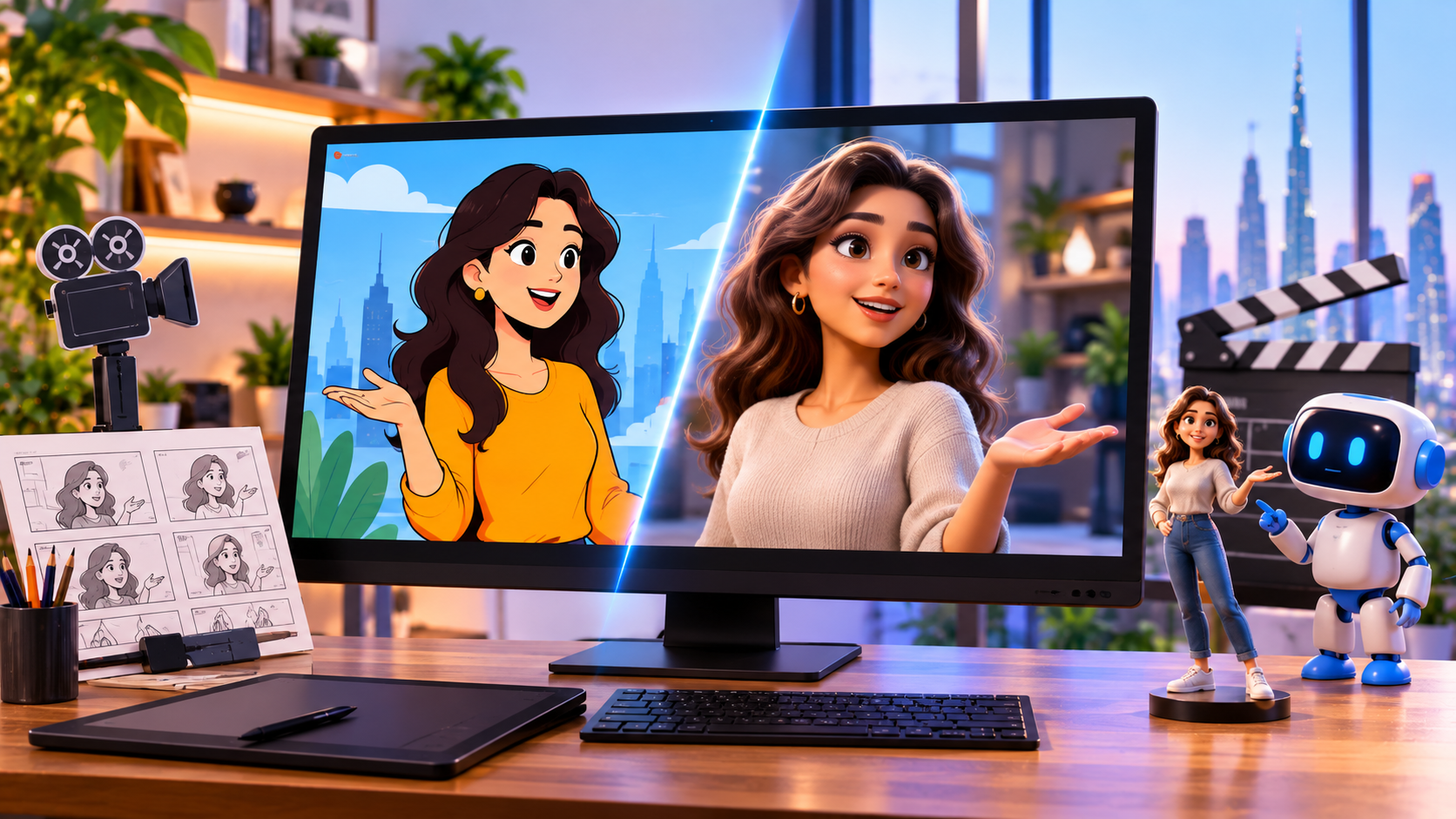
2D animation is better than 3D for most brand videos because it gets from brief to finished cut faster, costs less to change late, explains ideas more clearly, and is far easier to version into many ads, lengths and languages. 3D is the better pick when the viewer needs to see a real physical thing: a product's material, a building, or a mechanism moving in space.
That is the honest answer to why 2D animation is better than 3D: it usually is, for explaining, selling a service or app, and feeding a paid social account that needs fresh creative every few weeks. It is not better for everything. This guide gives you the reasons in detail, the cases where we would steer you to 3D instead, a side-by-side comparison, a decision matrix by industry with UAE examples, and a checklist for briefing a 2D animation that performs.
In this guide
- The short answer: where 2D beats 3D
- How 2D and 3D animation are made
- 7 reasons 2D animation is better than 3D for most brand videos
- When 3D animation is the better choice
- 2D vs 3D animation side by side
- Which to choose by industry and goal
- Hybrid, 2.5D and what AI changes
- How to brief a 2D animation that performs in ads
- Frequently Asked Questions
- Get the right format for your next campaign
The short answer: where 2D beats 3D
If you only read one section, read this one. 2D wins when the job is to make an idea clear and when you need to move fast or make lots of versions. 3D wins when the job is to make a physical object look real.
In practice, that splits brand work into two camps.
2D is usually the better choice for:
- Explainer videos for apps, fintech, SaaS, insurance, government services and clinics
- Social ads that need many hooks, lengths and aspect ratios
- Campaigns that run in both English and Arabic
- Seasonal content with a hard deadline, such as Ramadan, Eid, UAE National Day or a sale weekend
- Brands with an illustration style that already lives on the website and packaging
- Data, process and "how it works" stories where the viewer must follow steps
3D is usually the better choice for:
- Product films where texture, reflection and scale sell the product (perfume, jewellery, watches, electronics)
- Off-plan real estate, interiors and architecture
- Mechanisms and internals: engines, devices, medical products
- Hero launch films where a premium, cinematic look matters more than speed
Most of the "2D vs 3D" debate goes wrong because people compare the two as art forms. For a brand, the better question is narrower: what does the viewer need to understand or feel in the first few seconds, and how many versions of this will we need? Answer those two and the choice usually makes itself.
How 2D and 3D animation are made
To see why 2D is faster and cheaper to change, you have to see what each pipeline involves. Both start the same way: a brief, a script and a storyboard. The paths split once the visual work begins.
2D animation works on a flat canvas. Designers create the characters, icons and backgrounds as illustrations. Animators then move them, either by redrawing frames (frame-by-frame or "cel" style) or by moving and deforming flat pieces like a paper puppet (cut-out or rigged 2D). Motion graphics, the kinetic type and icon style common in explainers and ads, also sits in the 2D family.
3D animation builds objects in a virtual space. Artists model every object, apply materials (how metal, glass or skin reflects light), rig anything that bends, set up virtual lights and cameras, animate, and then render. Rendering means the computer calculates every frame from scratch, with every light bounce, which is slow for realistic scenes.
The stages below show where the time goes. The time share is a rough estimate from typical brand projects of 30 to 60 seconds, not a fixed rule: complex characters or heavy realism change it a lot.
Notice where 3D spends its time: setup and rendering. Those stages exist before you see a single finished frame, and they repeat whenever something changes. That is the root of most of the reasons below.
7 reasons 2D animation is better than 3D for most brand videos
These are the reasons we give clients when they ask us to choose. Each one is practical, not a matter of taste.
1. Faster from brief to first cut
A 2D project shows you its look on day one. The style frames are the final art, so what you approve is what you get. In 3D, the first images often come only after models, materials and lights are built, and an approved style frame still has to survive animation and rendering.
For a brand that needs a campaign live before a launch date or a holiday, this matters more than any visual preference. A team can storyboard, design and animate a short 2D ad while a 3D team is still building assets. If your media plan is fixed and the deadline is real, 2D removes risk.
2. Late changes cost far less
Every brand video changes after the first cut. Legal wants a line removed. The product team renames a feature. The offer moves from "free delivery" to "20% off".
In 2D, most of those changes mean editing a layer, a word or a scene, then exporting again. In 3D, a change that looks small on screen can touch the model, the lighting and the camera, and then every affected frame must be rendered again. Changing the color of a character's jacket in 2D is a fill. In 3D it is a material change plus a re-render.
This is why we tell clients who expect a lot of stakeholder feedback to start in 2D. The cost of being wrong is lower.
3. It explains ideas more clearly
2D can show things that do not physically exist: money moving between accounts, data flowing to the cloud, a symptom spreading through the body, a policy covering a family. It can simplify freely, drop the background to plain color, and point at exactly what matters with an arrow or a label.
3D tends to add detail, because detail is what it is good at. More detail means more for the eye to read and less attention on the message. For explainers, that is a cost, not a benefit. If you want to see how different 2D approaches handle this, our roundup of explainer video examples sorted by style shows whiteboard, flat icon and character formats side by side.
4. A look nobody mistakes for stock footage
Photoreal 3D and AI-generated video now look alike to many viewers. Both chase realism, and realism is getting common in feeds. A distinctive 2D style, with your colors, your line weight and your characters, is instantly recognizable and hard to copy.
That matters on social platforms, where the viewer decides in a second or two whether to keep watching. A strong illustrated look can act like a logo in motion. Once it is built, every new ad in the series is recognized as yours before the brand name appears.
5. Cheap to version for testing and languages
Paid social runs on variants: three hooks, two lengths, three aspect ratios, two languages. That is quickly dozens of files from one idea. In 2D, those variants mostly come from rearranging scenes, swapping text layers and reframing a flat canvas.
In the UAE this is a big deal, because many campaigns run in English and Arabic. Arabic reads right to left, so on-screen text, arrows, progress bars and even the direction a character walks may need to flip. In 2D that is a design pass. In 3D, anything baked into the render, such as a sign on a wall or text on a screen in the scene, means rendering again.
If you plan to test creative properly, the ability to produce variants cheaply is worth more than any single beautiful frame. Our creative testing framework for video ads explains how many variants a fair test needs and how to read the results.
6. Crisp on phones and light on file size
Flat color and clean edges compress well. A 2D ad usually stays sharp after a platform re-encodes it, while fine 3D detail like soft shadows, gradients and reflections can band or smear at the bitrates feeds use. Bold shapes also read at thumbnail size, which is how most people first meet your ad.
2D is also naturally comfortable with vertical 9:16 framing. You can design the composition for a phone screen from the start, keeping key elements inside the safe zones that platform interfaces cover. TikTok's own creative best practices push full-screen vertical video for exactly this reason.
7. Easier to keep on-brand all year
A 2D character or icon set is a design system. Once it exists, a designer can pose it in a new scene, give it a new prop, or put it on a static post, a story frame or a website banner. Social, website and print can all share one illustrated world.
3D assets can be reused too, and that is a real 3D strength we cover below. But building new 3D scenes still needs 3D specialists, while a 2D library can be extended by a wider range of designers. For brands that post every week, that difference adds up.
When 3D animation is the better choice
We make both, so we have no reason to oversell either. Here is where we would tell you to choose 3D, even though it takes longer.
Physical products where material sells
If the buyer is paying for how something looks and feels, 3D usually wins. The glint on a perfume bottle, the cut of a diamond, the brushed metal of a watch case, the soft fabric of a sofa: 2D can suggest these, but 3D can show them convincingly, from any angle, in perfect light.
For these categories, the realism is the message. Our guide to CGI product videos and when 3D beats a camera covers how those films are made and briefed, and our breakdown of 3D product animation examples by industry shows the shot types that work.
Off-plan property and architecture
You cannot film a tower that does not exist yet. For developers and brokers selling off-plan, 3D walkthroughs, flyovers and furnished interiors let buyers see views, layouts and finishes before handover. A 2D floor plan animation is useful as a supporting piece, but buyers want to picture themselves in the space.
This is one of the clearest 3D cases in the UAE market, and it is a big part of what we do for real estate video ads in Dubai.
Mechanisms, internals and devices
When the viewer must understand how parts fit and move in space, 3D is clearer. Think of an engine, a dental implant, a skincare applicator, a smart lock, or a medical device. 3D lets you cut the object open, rotate it, explode it into parts and put it back together. 2D cutaways can work for simple cases, but they get hard to follow as complexity rises.
Reuse across many films
Once a 3D product model exists, it can be rendered from any angle, in any setting, for years. A brand launching a range of bottles, cars or devices can build the master model once and get stills, turntables and ads from it. Here the up-front cost of 3D is spread over many outputs. If you will make dozens of product visuals of the same object, 3D can become the more efficient route over time.
Premium hero films
For a flagship launch, a brand film for a big event, or a campaign where a cinematic look signals quality, 3D's depth, lighting and camera moves can be worth the extra time. These are usually one or two hero pieces, supported by faster 2D or live-action cut-downs for social.
2D vs 3D animation side by side
The comparison below puts the main factors in one place. Use it to sense-check a choice before you brief anyone.
Neither column is better everywhere. But count how many rows matter for your project. For an app explainer or a social campaign, the 2D column wins most of the rows that count. For a perfume launch, the "product realism" row alone can decide it.
Which to choose by industry and goal
Industry is a good shortcut, because it tells you what the viewer needs to see. The matrix below is how we would start the conversation with a client in Dubai or the wider UAE. It is a starting point, not a rule.
Two notes on the UAE market specifically. First, many audiences here watch in both Arabic and English, so a format that versions cheaply has a real advantage. Second, seasonal moments like Ramadan, Eid and National Day come with fixed dates. When the deadline cannot move, the faster pipeline usually wins.
Hybrid, 2.5D and what AI changes
The best answer to "2D or 3D?" is often "both". Many of the ads you scroll past are already hybrids.
Hybrid and 2.5D
2.5D means flat 2D artwork placed in layers with a little depth between them, so the camera can drift and parallax creates a sense of space. You get some of 3D's depth for close to 2D's effort.
Hybrid means mixing the two: a 3D product model dropped into a 2D illustrated world, or 2D icons and type animated over 3D footage. A common pattern for product brands is a 3D hero shot of the product for realism, with 2D motion graphics around it for the benefits, the offer and the call to action. That way the realism goes where it sells, and the cheap-to-change parts stay flat.
What AI changes
AI video tools have shifted the decision in two ways.
First, AI generation makes photoreal footage much faster to produce. That puts pressure on the realism advantage of 3D for some mood and lifestyle shots, though it does not replace 3D where exact product accuracy matters. AI clips can drift in shape, label and color from frame to frame, which is a problem when the product must look exactly like what ships.
Second, AI can help animate 2D work. Turning a still illustration or a product render into a short moving clip is now routine, and our guide to what AI image to video is and how start frames work explains the method and where it fails. Used carefully, it shortens the path from a style frame to motion.
The net effect: realism alone is less rare than it was, and a consistent, ownable style is worth more. That favors 2D for most always-on brand content, with 3D or AI realism used where it does a specific job. If you use realistic synthetic visuals, also check platform rules: YouTube, for example, asks creators to disclose realistic altered or synthetic content.
How to brief a 2D animation that performs in ads
If you have decided 2D is right, the brief decides whether it works. These are the steps we follow with clients.
- Write the one sentence the viewer must remember. If you cannot say it in one line, the animation will not either. Everything in the script supports that line.
- Decide the formats before the storyboard. List every placement and aspect ratio you will run: 9:16 for Reels, Stories and TikTok, 1:1 or 4:5 for feeds, 16:9 for YouTube and your website. Design scenes so they can be reframed without losing the key element.
- Plan the hook for the first seconds. Show the problem or the payoff immediately. Do not open on a logo animation; the viewer has not decided to care yet.
- Design for sound off. Most feed viewing starts muted, so on-screen text must carry the message. Keep lines short and large, and add captions for voiceover.
- Build a style frame set, not just one frame. Ask for three or four approved frames showing characters, color, type and a busy scene. These become the rules for every future ad.
- Script both languages at the same time. Arabic often runs longer or shorter than English, and it reads right to left. Plan scene timing and text areas for both from the start, so the Arabic version is not an afterthought.
- Ask for a variant plan. Agree up front which hooks, lengths and calls to action you will test, and make sure scenes are built as separate modules so they can be recombined.
- Keep the call to action specific. Tell the viewer exactly what to do next: download, book, call or shop. Repeat it in the final frame with enough time to read it.
- Review against the brief, not taste. At each round, ask whether the scene serves the one sentence from step 1. This keeps feedback short and stops endless style debates.
Follow these and 2D's strengths, speed, clarity and cheap variants, show up in your results instead of staying theoretical.
Frequently Asked Questions
Is 2D animation cheaper than 3D?
Usually, yes, for the same length and level of polish. 2D skips several 3D stages, such as modeling, texturing, lighting and long render times, and changes are quicker to make. The gap narrows for very detailed frame-by-frame 2D, and 3D can become efficient when one model is reused across many films. The real cost depends on length, complexity, characters and deadline, so it is best to get a quote for your specific brief.
Is 2D animation outdated?
No. 2D is everywhere in apps, explainers, social ads, interface design and broadcast. What has changed is the toolset: most 2D is now made digitally, with rigs and motion graphics instead of every frame drawn on paper. Its flat, stylized look is often a deliberate brand choice, because it reads clearly on phones and stands apart from the growing amount of realistic footage in feeds.
Is 2D or 3D better for social media ads?
For most social ads, 2D is the better default. It is faster to produce, cheaper to version into many hooks, lengths and aspect ratios, and reads well at small sizes on muted feeds. Choose 3D when the product's look is the selling point, such as perfume, jewellery or electronics, or use a hybrid: a 3D product shot surrounded by 2D text and graphics.
When should a brand choose 3D animation over 2D?
Choose 3D when the viewer must see something physical in convincing detail: a product's materials, an off-plan building or interior, or a mechanism moving in space. It also makes sense when one master model will be reused for many films over months or years, or for a premium hero launch where a cinematic look signals quality and speed matters less.
Is 2D animation easier to learn than 3D?
For most people, 2D is easier to start, because it builds on drawing and design skills and has fewer technical stages. 3D requires learning modeling, materials, rigging, lighting and rendering before results look good. That said, high-end 2D character animation takes years to master too. Easier to start does not mean easy to do well.
Can you combine 2D and 3D in one video?
Yes, and many strong brand videos do. A common approach is a 3D product hero shot for realism, with 2D motion graphics for benefits, offers and the call to action. Another is 2.5D, where flat artwork is layered with depth so the camera can move. Hybrids put realism where it sells and keep the parts that change often cheap to update.
Get the right format for your next campaign
So, why is 2D animation better than 3D? For most brand videos it is faster, clearer, cheaper to change and far easier to turn into the many versions paid social needs, in English and Arabic. 3D earns its place when realism is the message: products, property and mechanisms.
We make both at XMA, from 2D explainers to CGI product films, so we will recommend the one that fits your goal rather than the one that is bigger to sell. See what our motion graphics and CGI team in Dubai produces, then book a strategy call to get a quote for your next animation.